How a complete off-grid system works
An off-grid system is made up of several parts that together produce, store and use energy. This guide covers how batteries, solar panels, controllers, inverters, DC-DC charging and fuses work together in modern 12V and 24V systems.
How the battery, solar, inverter and charging fit together
A modern off-grid system is made up of several components that together create a self-sufficient power system.
Among other things, the system can be used in:
Campervans / overlanding
Motorhomes / caravans
Boats
Off-grid cabins
Hunting huts
Backup and emergency systems
But for many people it is hard to see how it all actually fits together.
In this guide we cover:
The parts of the system
How the current flows
What each component does
The difference between DC and AC
How to build a stable and efficient system
The basic principle
1. Produce energy
You can produce energy through, for example:
Solar panels
An alternator
Shore power
2. Store energy
All the energy produced has to be stored somewhere.
You can use, for example:
Lithium batteries
AGM batteries
3. Use energy
These are examples of things that draw energy from the store:
A fridge
A coffee maker
Charging electronics, a phone for instance
Lighting
The whole system is tied together by:
Controllers
Fuses
Cables
Charging systems
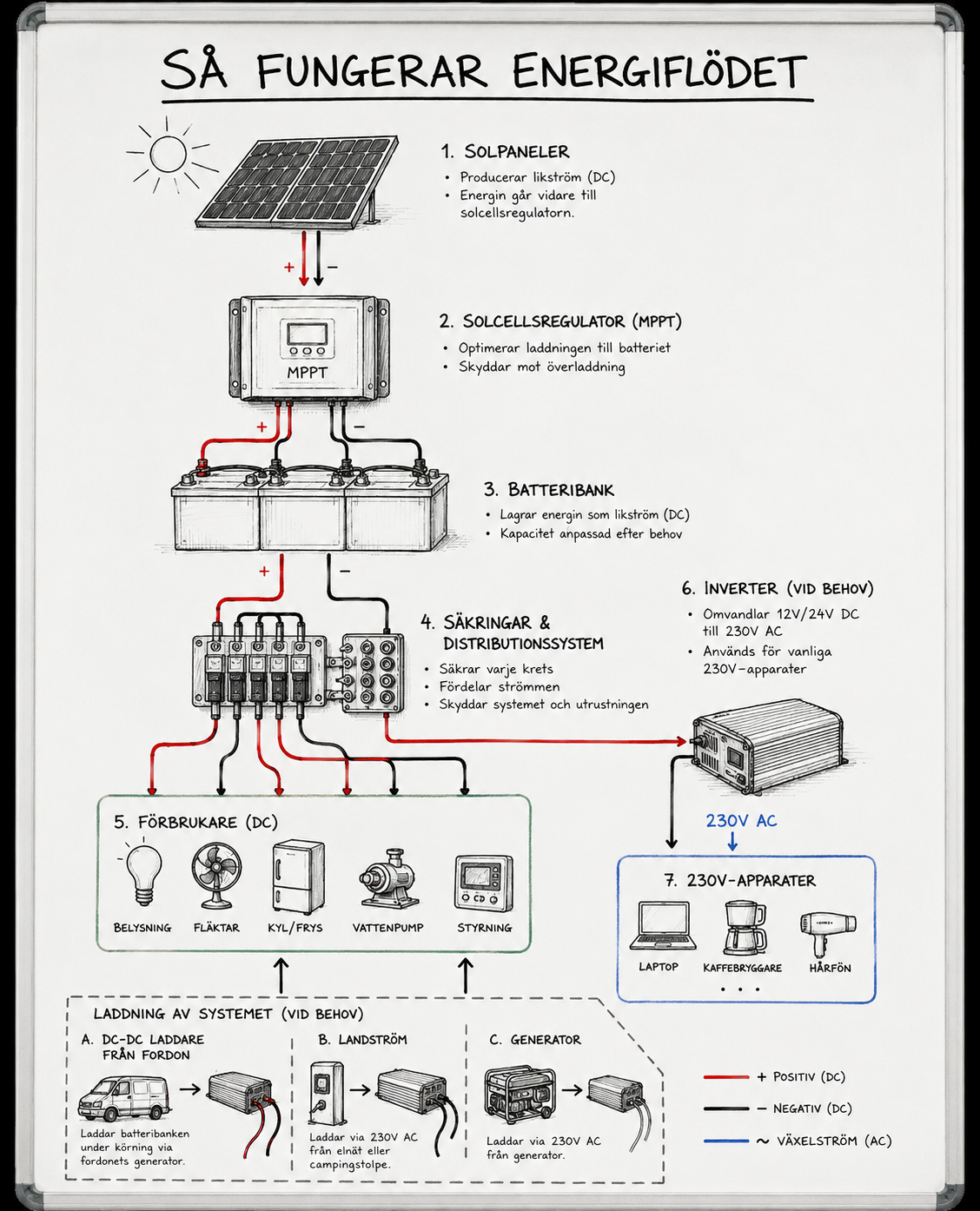
The battery — the heart of your system
The battery bank stores the energy produced by the solar panels and by DC/DC charging, for example.
It is the battery that runs things like:
The fridge
Lighting
The water pump
The inverter
Modern off-grid systems often use LiFePO4 (lithium iron phosphate).
The advantages of LiFePO4:
Long life
Low weight
Fast charging
High efficiency
Solar panels — the system's energy source
Solar panels produce electricity from sunlight. But the panels cannot be connected straight to the battery. That is why a charge controller is needed.
The solar charge controller — the system's control unit
The controller sits between the solar panels and the battery bank. It regulates the charging, protects the battery and optimises energy production.
In a modern system we recommend using an MPPT controller. They are more efficient and work better in a Nordic climate.
DC systems: 12V vs 24V
Most off-grid systems are built on 12V DC, but 24V is also common (above all in boats), and for off-grid cabins even 48V can make sense.
Many appliances run straight off DC:
Fridges
Lighting
USB charging
Water pumps
The higher your system voltage, the thinner the cable that can move the same amount of energy.
AC systems — 230V through an inverter
Ordinary household appliances need 230V alternating current. That is where an inverter comes in. Make sure your inverter produces a pure sine wave, so sensitive electronics are not damaged.
The inverter converts:
12V DC to 230V AC (with a 24V or 48V system the same thing happens, just with a different input voltage at the inverter).
That lets you use:
A coffee maker
A laptop charger
An induction hob
Power tools
A TV
Kitchen equipment
When do you need an inverter?
An inverter is needed when the appliance requires 230V AC. But many systems become more efficient if as much as possible runs directly on DC.
Every voltage conversion creates losses. That is why many modern off-grid systems favour 12V or 24V appliances wherever they can.
DC-DC charging from the vehicle
In vehicle systems (motorhome, caravan, campervan, boat) the battery is often charged while driving.
A DC-DC charger is normally used for that. It protects the alternator, gives the correct charge profile, works with smart alternators and charges your lithium battery properly.
Shore power
Many systems can also be charged from:
A campsite
A marina
A garage
A 230V socket at home
A battery charger or a combi charger is used for that.
It lets the battery charge quickly, stay topped up, and run the system without drawing on the battery as heavily.
Fuses — one of the system's most important parts
Fuses protect:
Cables
Equipment
The system
Not the appliance.
Every major component should be properly fused:
The battery
The inverter
The DC-DC charger
The controller
The distribution panel
The main fuse must always sit close to the battery.
Cable sizing
In a low-voltage system the current gets high.
I = P / U (amps = watts / volts)

Example: a 3000W inverter in a 12V system:
I = 3000 / 12 ≈ 250 A
That is why it takes thick cable, short runs and correct fusing.
How to build a balanced system
A good off-grid system is about balance between:
Battery capacity
Solar production
Charging
Consumption
Too small a battery bank gives you a short run time. Too little solar means slow recharging. Too small an inverter cannot run the appliances.
That is why system design matters.
Common mistakes
Too large an inverter
Can mean high idle consumption.Too small a battery bank
Gives a short run time.Cable that is too thin
Causes voltage drop and heat.No main fuse
A serious safety risk.Cheap controllers
Can cut energy production considerably.Too much 230V
Creates unnecessary losses.
Why modern systems are usually built on lithium + MPPT + DC-DC
This has become the standard in modern premium systems because it gives:
Fast charging
High efficiency
Low weight
A better energy harvest
Longer life
Perfect for:
Van life
Overlanding
Motorhomes / caravans
Boats
Off-grid living
Kraftur's recommendations
For modern off-grid systems we recommend:
LiFePO4 batteries
MPPT controllers
DC-DC charging (when it is fitted in a vehicle)
Correct cable sizing
A pure sine wave inverter
Quality components
A well-built system is not only about power — it is about balance, safety and staying reliable over time.